The water is clear, the fish are eating, the filter is humming along. In a tank like that, a water change can feel like a chore you could skip. Usually the regular water change is the reason things look that good. Skip it and nothing happens at first. The trouble arrives weeks later, and by then it is hard to trace back to the cause. This guide explains why we change water at all, how much and how often makes sense, and why tap water needs preparing before it goes anywhere near your fish.
Clear water is not always clean water
An aquarium is a closed system. A stream is constantly refreshed, but whatever goes into a tank stays in it. Fish eat and produce waste, and leftover food and dead leaves break down. Beneficial bacteria living in the filter convert the ammonia from all this into nitrite, and then into nitrate. Ammonia and nitrite are dangerous to fish even in small amounts. Nitrate is far less harmful, but the filter does not remove it. Plants use some, and the rest builds up week after week.
Nitrate is not the only thing accumulating. Dissolved organic compounds increase without being visible, and over time they can give the water a faint yellow tint and a heavy smell. Meanwhile other things run down. The minerals that fish, plants and bacteria use are slowly depleted, and so is the buffering capacity (carbonate hardness) that keeps pH steady. This is what fishkeepers mean when they talk about "old" water.
None of this makes the water cloudy. Water with high nitrate and depleted minerals can look like glass, which is why appearance is a poor guide. A calendar and a test kit are more reliable.
One common misunderstanding is that topping up evaporated water counts as a water change. Only water evaporates. Nitrate, organics and minerals stay behind, slightly more concentrated in the water that is left. Do top up, but the only way to get waste out of the tank is to take some of the water out with it.
How much, and how often?
The widely accepted approach is small and regular. In most aquariums, changing somewhere between a fifth and a third of the water once a week works well. Think of that as a starting point. A heavily stocked tank, or one with messy fish such as goldfish, needs larger or more frequent changes. A densely planted tank with only a few fish can stay balanced with less, because the plants take up part of the nitrate.
We don't recommend rare, large changes, because what fish struggle with is sudden difference. In a tank that goes months without a change, the water drifts slowly away from what comes out of the tap, and the fish adjust to that slow drift. Replace most of the water in one go and pH and hardness shift all at once. That is usually the story behind "I changed the water and my fish got sick." The same reasoning applies when you are rescuing a neglected tank: do several small changes a few days apart instead of one big one.
Why tap water needs preparing
Tap water is disinfected so that people can drink it safely. The chlorine used for this is harmless to us at those levels, but it irritates fish gills and damages the beneficial bacteria in the filter. Unprepared tap water therefore affects both the fish and the tank's biological balance.
The traditional fix is to let the water stand for a day. There is some truth in it: chlorine is volatile and gradually escapes from water left in an open container. The catch is that many water suppliers now use chloramine alongside or instead of chlorine. Chloramine is chlorine bonded to ammonia, and suppliers choose it because it lasts longer in the pipes. For the same reason, standing does little to remove it. Heavy metals such as copper, which can enter the water from plumbing, don't go anywhere either. Most of us don't know which disinfectant is in our tap water, and it can change over time.
A water conditioner takes that guesswork away. We developed Aqua Conditioner for this job: it binds the chlorine, chloramine, ammonia and heavy metals in tap water. Ammonia is on that list for a reason, since breaking down chloramine releases the ammonia it contains. It can be used in freshwater, saltwater and planted aquariums, and it is safe for shrimp, snails and plants.
Dosing is simple: 5 ml, about 75 drops, for every 200 liters (50 gallons) of change water. For small bucket changes, 1 drop per liter is a practical measure (roughly 15 drops make 1 ml). Stir the water and let it stand for 30 minutes. Chlorine is neutralized instantly, while binding ammonia and heavy metals takes a little longer.
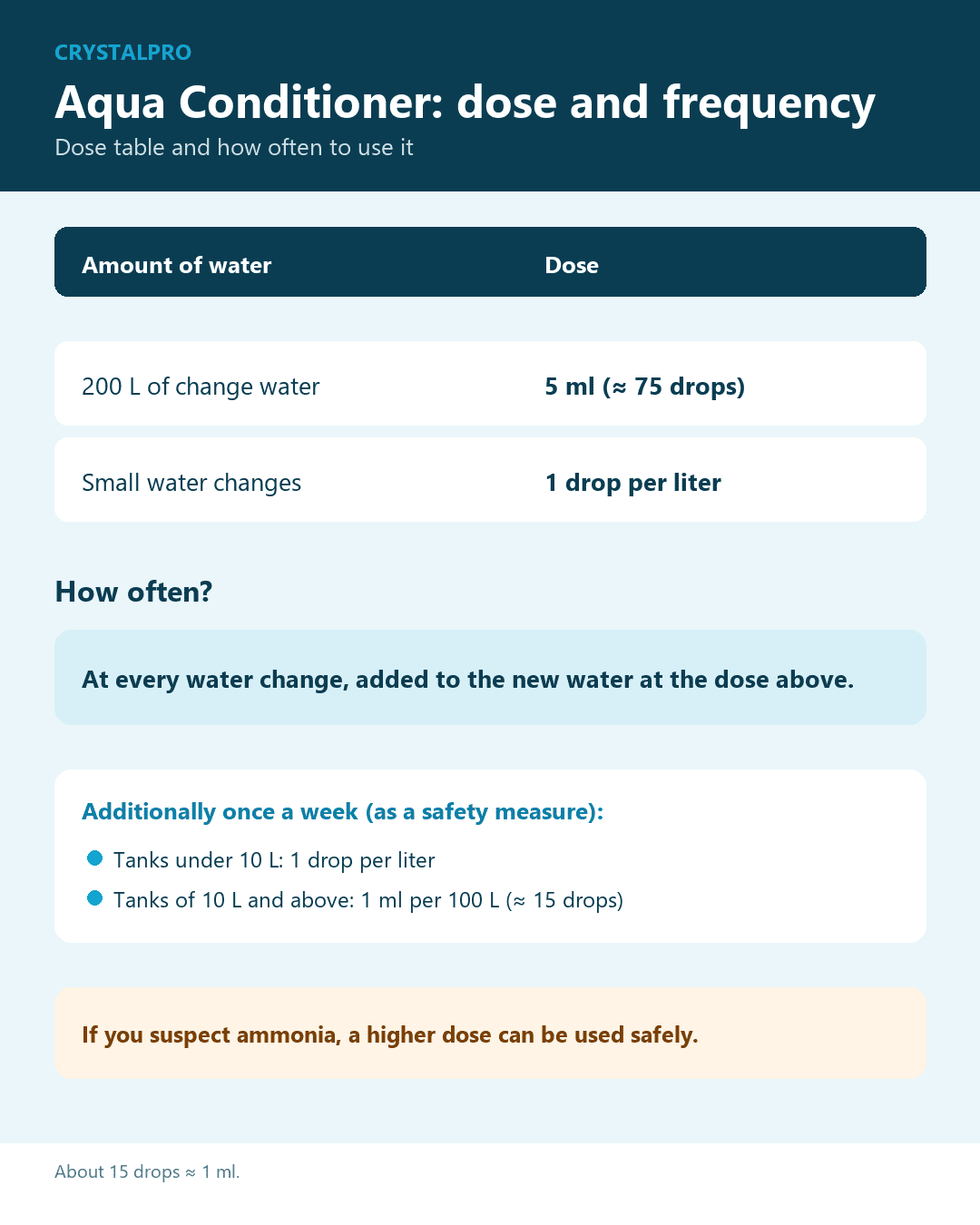
Use the conditioner at every water change. If you like, you can also add a weekly safety dose between changes: 1 ml per 100 liters in tanks of 10 liters and above, or 1 drop per liter in anything smaller. If you suspect ammonia, a higher dose can be used safely.
A water change, step by step
You will need a bucket kept only for the aquarium (detergent residue harms fish), a siphon hose and a thermometer.
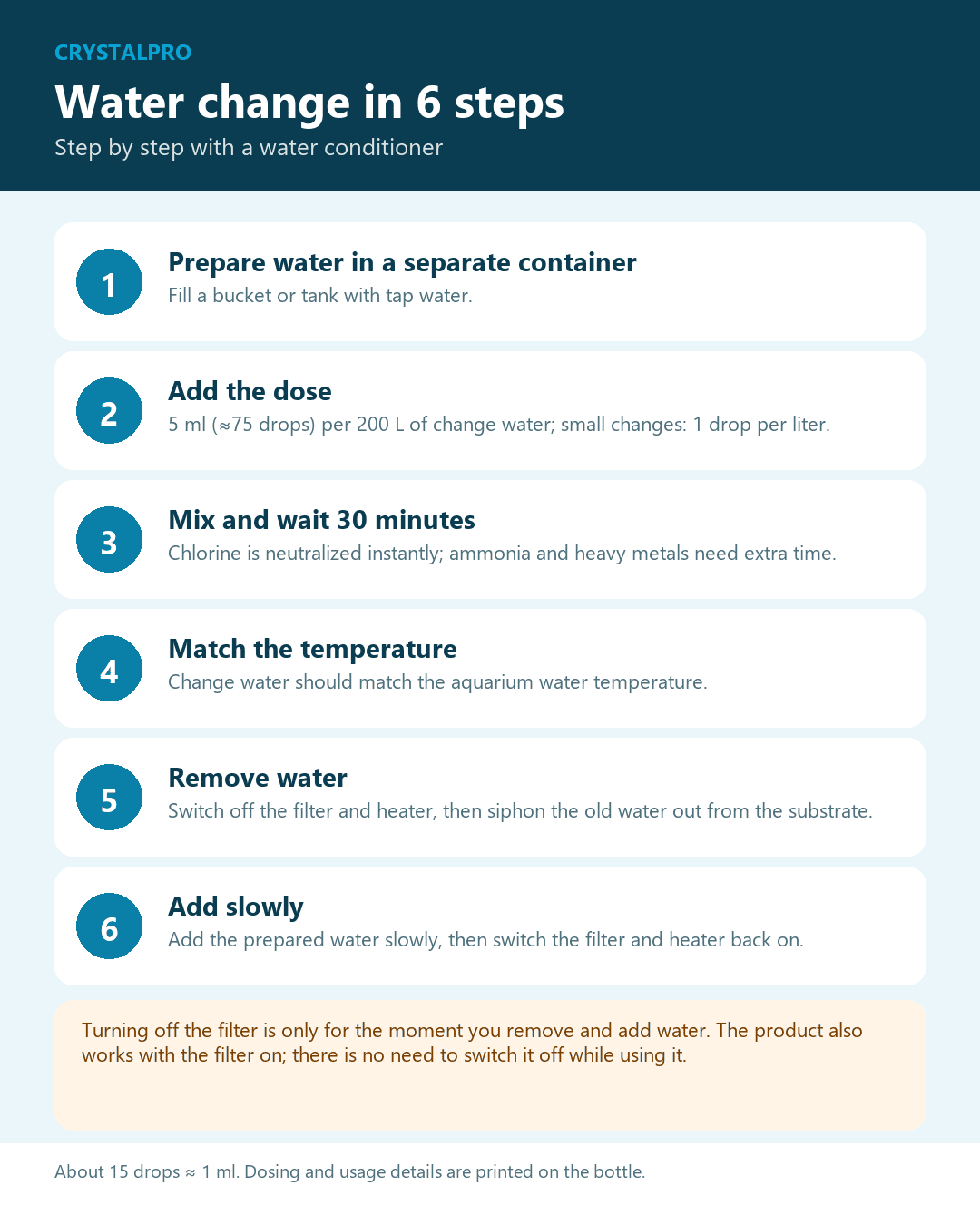
- Fill a separate container with the new water.
- Add water conditioner for the amount of water you have prepared.
- Stir and wait 30 minutes. This is a good moment to wipe the glass.
- Bring the new water to the same temperature as the tank.
- Switch off the filter and heater, then siphon the old water out from the substrate.
- Add the prepared water slowly, then switch the filter and heater back on.
A few of these steps deserve a closer look.
Matching the temperature
Fish cannot regulate their own body temperature, so they are as warm or as cold as the water around them. A sudden difference of a few degrees stresses them, and a stressed fish is more vulnerable to disease. Tap water is often much colder than the tank, especially in winter. Mix warm and cold water as you fill the bucket to get close to the tank's temperature, and check with a thermometer instead of trusting your hand.
Cleaning the bottom
Siphoning water from the bottom, instead of scooping it off the top, gets two jobs done at once. Leftover food and waste settle in the substrate and keep polluting the water as they decay. In gravel, push the wide end of the siphon into the bed; the dirt lifts and goes down the hose while the gravel drops back. Over fine sand, hovering the tube just above the surface is enough. In a planted tank, leave the area around the roots alone. You don't have to clean the whole bottom every time either. Doing one half this week and the other half next week is enough for most tanks.
The filter and heater are switched off because of the water level: as it drops, the heater can end up exposed to air and the filter can run dry. It has nothing to do with the conditioner, which does not need the filter to be off in order to work. Remember to switch both back on once the tank is full.
Adding the new water
Don't empty the bucket in one go. Pour slowly over your hand or onto a plate. This keeps the substrate in place, leaves plants rooted, and lets the fish get used to the new water as it mixes in.
With a large tank you may prefer to refill straight from a hose instead of carrying buckets. In that case add the conditioner to the aquarium and dose for the total tank volume, not just the water you are replacing. We still recommend preparing water in a separate container, because by the time it reaches the fish it is already safe.
Filter maintenance belongs on a different day
Most of the beneficial bacteria live on the filter media and on the surface of the substrate. Vacuum the substrate and clean the filter on the same day and you disturb both colonies at once. Leave filter maintenance for a separate day.
When that day comes, don't rinse sponges or ceramic media under the tap. Chlorinated water harms the bacteria that have spent weeks growing there. Take some water out of the aquarium and squeeze or swish the media in that. You are not trying to make it look new, only to clear the clogging so water can flow through freely again.
Common mistakes
The most common one is emptying the tank completely and scrubbing everything. It is done with good intentions, but it resets the biological balance and drops the fish into very different water. The second is doing nothing for months and then trying to catch up with one huge change. The third comes from rushing: a tank refilled without conditioner, or without checking the temperature. And there is a small but annoying one, which is the heater and filter left switched off after the job is done.
Frequently asked questions
Wouldn't changing all the water be cleaner? No. What keeps an aquarium healthy is stable conditions, and new water alone doesn't provide that. A partial change dilutes waste while keeping the environment the fish are used to.
The water went slightly cloudy after a change. Is that normal? Usually, yes. Fine debris stirred up while siphoning stays suspended for a while, and the filter generally clears it within a few hours. If it happens every time, try adding the new water more slowly.
I'm going away. Does it matter if I skip a week? In a well-maintained tank, generally not. Do your normal change before you leave and pick up where you left off when you return. Don't try to make up for it with a very large change.
Should I do the same in a shrimp tank? The principle is the same, but shrimp are more sensitive to sudden change than fish. Keep the changes small and add the new water even more slowly.
Once it becomes a habit, a water change is a quick job, and it is one of the most useful things you can do for an aquarium. Keep it small, keep it regular, and never add water you haven't prepared.